Claude Opus 5 vs Sonnet 5: Which One Should You Actually Pay For?
Opus 5 costs two and a half times as much as Sonnet 5 on output tokens. That's not a rounding difference — it's the kind of gap that should make you stop and ask whether Claude Opus 5 vs Sonnet 5 is actually a two-and-a-half-times difference in value, or just a premium for a name.
The short version: most of the time, no, you don't need Opus 5. But there's a specific slice of work where the extra cost pays for itself many times over, and knowing which side of that line you're on is the point of this article. We'll walk through pricing, benchmarks, real coding scenarios, and — because most comparisons stop at “here's a spec sheet” — actual monthly cost math for a few different kinds of users.
The Short Answer
If you want the verdict before the details: run Sonnet 5 by default, and escalate to Opus 5 only when one of these is true.
You're doing a multi-file refactor or working across a codebase large enough that losing track of context causes real bugs.
You're running a long, unattended agent workflow — ten or more tool calls in a chain — where a mistake halfway through wastes everything after it.
The decision itself is ambiguous or high-stakes: architecture calls, legal or financial analysis, anything where a wrong answer is expensive to catch later.
You're doing research-grade reasoning, the kind of problem where you'd want a second, more careful opinion even from a human.
Everything else — day-to-day coding, drafting, summarizing, answering questions, quick iteration — Sonnet 5 handles well, at a fraction of the cost. The rest of this piece explains why, with numbers.
What Opus 5 and Sonnet 5 Actually Are
Anthropic shipped these two models a few weeks apart in the summer of 2026: Sonnet 5 on June 30, and Opus 5 on July 24. They share the same underlying safety and compliance stack but are built for different jobs.
Anthropic's own framing is useful here. Sonnet 5 is pitched as “the best combination of speed and intelligence” — a capability upgrade over its predecessor at a lower price, strong enough for most day-to-day coding and knowledge work without stepping up to an Opus-class model. Opus 5 is built “for complex agentic coding and enterprise work,” and Anthropic describes it as delivering “frontier intelligence at half the cost” of Claude Fable 5 — the top-tier model at the time Opus 5 launched. Fable 5 has since been succeeded by Fable 5.1, released September 1, 2026, so that comparison was against the top tier as it existed in July, not the current one.
In practice, the decision isn't “which model is smarter.” It's closer to “how much of that extra headroom do you actually need for what you're doing today.”
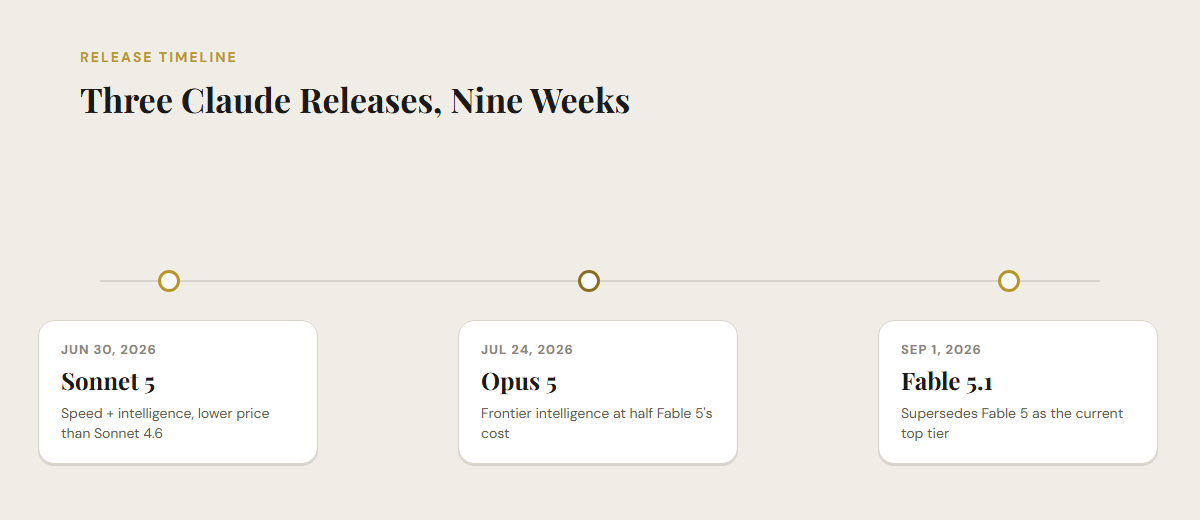
Three Claude releases in nine weeks — Sonnet 5, then Opus 5, then Fable 5.1 superseding Fable 5.
Pricing: What Each Model Actually Costs
Here's where the two models actually diverge, in dollars. This is Anthropic's own current pricing table:
Model | Input (per million tokens) | Output (per million tokens) |
|---|---|---|
Haiku 4.5 | $1 | $5 |
Sonnet 5 | $2 | $10 |
Opus 5 | $5 | $25 |
Fable 5.1 | $10 | $50 |
Opus 5 costs the same per token as its predecessor, Opus 4.8 — Anthropic didn't raise the price of its flagship model, which is notable given that flagship pricing usually climbs with each release. That makes it half the price of Fable 5.1, the current top tier.
Subscription-wise, the plans don't map quite as cleanly as “one model per plan.” Sonnet 5 is the default on the Free and Pro plans, and Opus 5 is the default on Max — but Opus 5 is also available on Pro, where Anthropic describes it as the strongest model you can select, just not the one you get automatically. If you're paying for Pro and haven't manually switched models, you're on Sonnet 5 day to day, with Opus 5 one selection away.
There's a catch worth knowing before you assume Sonnet 5 is simply “cheaper, same output.” Sonnet 5 uses a new tokenizer that produces roughly 30% more tokens than its predecessor, Sonnet 4.6, for the exact same text — the precise increase depends on the content. That doesn't erase the price advantage: per-token, Sonnet 5 is explicitly priced lower than Sonnet 4.6 was, and it's still meaningfully cheaper than Opus 5 per task in almost every real workload. But it does mean the sticker-price gap slightly overstates the real-world savings, and any token budgets or cost projections you had dialed in for an older model need to be re-measured, not assumed. If you want the bigger picture on why AI pricing keeps moving like this even as headline rates fall, we've covered that separately in our look at AI token costs in 2026.
Benchmarks: What the Numbers Actually Show
This is where most comparisons get sloppy, so it's worth being precise about what we actually know — and honest about what we don't.
Anthropic evaluated the two models very differently at launch. For Opus 5, the company highlighted a specific set of comparative results: state-of-the-art performance on Frontier-Bench v0.1 (more than double Opus 4.8's result), a score within 0.5% of Fable 5's peak on CursorBench 3.2 at half the cost, an ARC-AGI 3 score roughly three times the next-best model, a result on OSWorld 2.0 that beat Fable 5's best score at about a third of the cost, and a pass rate on Zapier's AutomationBench about 1.5 times the next-best model. Those are Anthropic's own comparative claims, not independently audited scores — worth keeping in mind as you read them.
For Sonnet 5, Anthropic's own materials are notably less specific. The company states that the largest gains over Sonnet 4.6 are in coding and agentic tasks, and points readers to its Transparency Hub for detailed data rather than publishing a headline scorecard in the launch announcement. Third-party sites have circulated a wide range of specific numbers for Sonnet 5 on benchmarks like SWE-bench Verified and GPQA Diamond, but they disagree with each other by ten or more percentage points on the same benchmark — enough that we won't repeat any single figure here as settled fact. If you need exact, sourced benchmark numbers for Sonnet 5, Anthropic's Transparency Hub is the place to look, not a secondary aggregator.
One data point from third-party benchmark trackers puts Sonnet 5 at 80.4% and Opus 5 at 89.1% on Terminal-Bench 2.1 — the same benchmark, which would make it one of the few genuinely apples-to-apples comparisons available. Other sources report a different figure for Sonnet 5 on the same test, so treat this specific pairing as directionally interesting rather than confirmed.
The practical read, even accounting for the messy sourcing: Opus 5 pulls ahead on the harder, more open-ended end of the spectrum — long-horizon agent tasks, unusual reasoning problems, tasks resembling ARC-AGI-style pattern generalization. Sonnet 5 is close enough on routine coding and knowledge-work tasks that most everyday use won't show a difference you'd notice without a score sheet in front of you. If you're weighing Claude against other providers rather than against itself, our GPT-5.4 vs Claude Opus 4.6 comparison covers that ground separately.
Coding and Agentic Work: Where the Gap Shows Up
Benchmarks don't tell you what it's actually like to work with these models day to day. Here's where the difference shows up in practice.
For single-file changes, routine bug fixes, small feature additions — the kind of coding you do dozens of times a day — Sonnet 5 is fast and reliable. It writes clean code, follows instructions well, and rarely needs a second pass for this class of work. There's no real reason to reach for Opus 5 here; you'd be paying more than double for output you likely can't tell apart.
The gap opens up on multi-file refactors and longer agentic sessions: the kind where a model needs to hold a mental model of a whole codebase, track how a change in one file ripples into three others, and keep making good decisions twenty or thirty tool calls into a task without losing the thread. This is where Opus 5's extra reasoning depth earns its price. Anthropic specifically highlights agentic coding and long-horizon tasks as one of Opus 5's biggest gains over its predecessor, including completing multi-file features and larger refactors “without leaving stubs or placeholders” — the kind of subtle incompleteness that doesn't show up until you're debugging a merge three days later.
There's a practitioner pattern worth mentioning here, since it captures the whole idea in one command. Claude Code has a built-in mode — invoked with /model opusplan — that uses Opus for planning a task (architecture, breaking down the approach) and hands the actual execution off to Sonnet for everything else. It's a neat encapsulation of the broader strategy: spend the expensive model's time on the decisions that matter, and let the cheaper model do the typing.
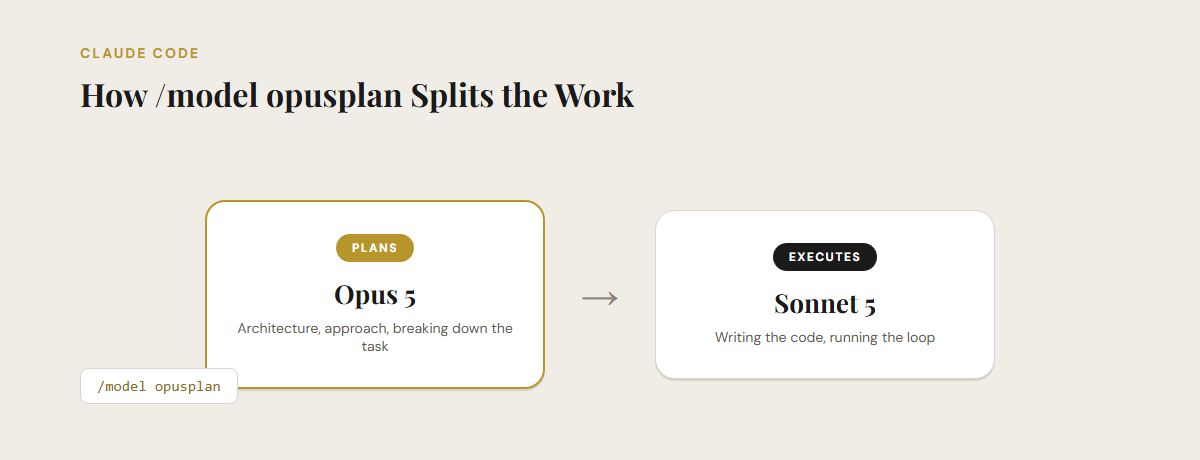
Opus 5 plans, Sonnet 5 executes — the opusplan pattern in one picture.
Context Window and Reliability
There's a fair amount of confusion online about Opus 5's context window, so it's worth settling clearly, straight from Anthropic's own documentation.
Both Opus 5 and Sonnet 5 have a 1-million-token context window that's explicitly both the default and the maximum on paid plans — there's no smaller variant to opt into or out of, and no long-context surcharge at standard API pricing. That's roughly 555,000 words: enough to hold a full-length novel, a mid-sized codebase, or a long stretch of conversation history in one go. Both models sit in the same tier as Fable 5.1 on context size; only the smaller, faster Haiku 4.5 is capped lower, at 200,000 tokens.
We did come across one third-party account claiming Opus 5 defaults to a much smaller 200,000-token window on claude.ai unless a specific account setting is enabled. That claim conflicts directly with Anthropic's own current documentation, which states plainly that there's no smaller variant. We can't reconcile the two, and since it contradicts the primary source, we'd treat the 1M-as-standard answer as the reliable one — but if a workflow depends on the full window, it costs nothing to double-check your specific interface and settings before relying on it.
Both models also ship with adaptive thinking on by default and a maximum output of 128,000 tokens per response. That means both tend to spend more time, and more tokens, working through a problem before answering than their non-thinking predecessors did — part of why revisiting your token budgets matters when you migrate, independent of which model you choose.
Real Monthly Cost, by Usage Profile
Pricing tables are abstract. Here's what the numbers actually look like for a few kinds of people who might be reading this. These are illustrative estimates, not measured averages — your actual usage will vary — but they should give a realistic sense of scale.
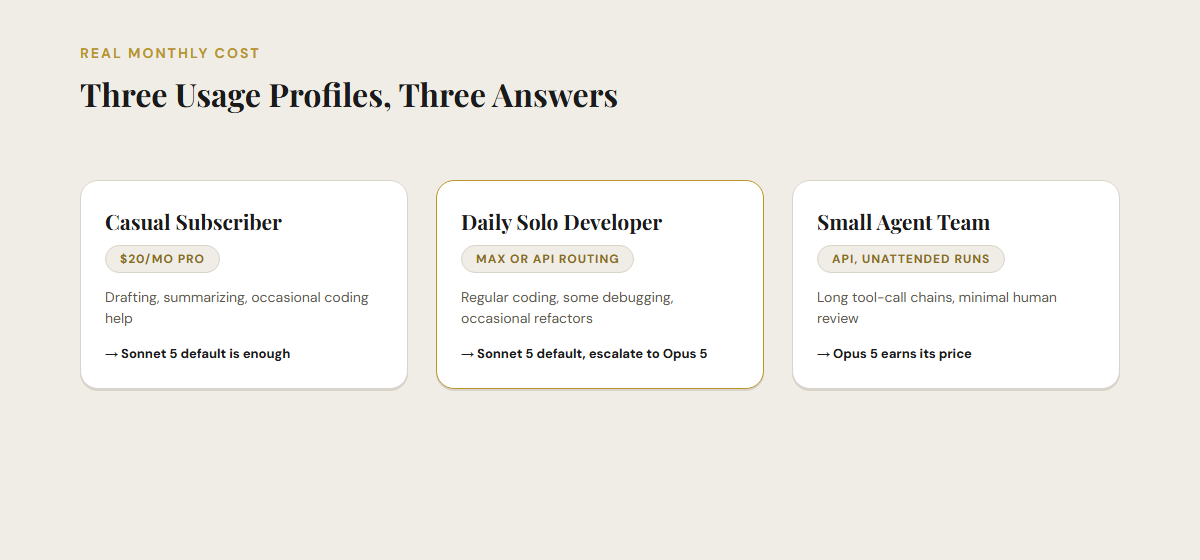
The casual subscriber. You use Claude for drafting emails, summarizing documents, occasional coding help, and general questions — maybe a few dozen conversations a week. A $20/month Pro plan, running on Sonnet 5 by default, comfortably covers this. There's no scenario here where switching to Opus 5 changes your day-to-day experience enough to justify the jump to a Max plan.
The daily solo developer. You're coding most days, using Claude for real feature work, some debugging, and occasional larger refactors. This is the profile where the decision actually gets interesting. A Max plan gives you Opus 5 as the default, with Sonnet 5 available underneath it — or, on the API, you could run a routing setup that sends routine work to Sonnet 5 and escalates the harder slice of tasks to Opus 5. For someone generating a meaningful volume of output tokens daily, that kind of routing keeps Opus 5 usage — and its cost — confined to the work where it actually changes the outcome, rather than paying the premium on every request.
The small team running agent workflows. Your agents do longer, less-supervised work: pulling data, running multi-step processes, operating with minimal human review in the loop. Here, the calculus shifts. A failed or half-completed agent run that has to be caught, debugged, and re-run can easily cost more in wasted time than the token-price difference between the two models. For unattended or high-stakes agentic work specifically, Opus 5's stronger performance on long tool-call chains is often worth the premium — you're not just buying more tokens, you're buying fewer expensive failures.
The Routing Strategy Teams Actually Use
The pattern that comes up again and again, across teams running this in production, is simple: default to Sonnet 5, escalate to Opus 5. Route the bulk of routine, high-volume work to Sonnet 5, and reserve Opus 5 for the smaller slice of tasks where the added reasoning depth changes the outcome — architecture decisions, complex debugging, long agent chains, anything where getting it wrong is expensive.
Claude Code's opusplan mode, mentioned above, is one built-in version of this idea. If you're building your own routing logic rather than using a tool that has it baked in, keep the model choice as a configuration value you can change in one place, not something hardcoded across your codebase — pricing and model capabilities are clearly still moving targets less than two months after both of these launched.
When Sonnet 5 Is Enough vs When Opus 5 Earns Its Price
Pulling the threads together:
Sonnet 5 is enough if:
You're doing routine coding, drafting, summarizing, or day-to-day chat work.
You're cost-sensitive and running high volumes of requests.
Your tasks are well-defined and don't require holding a huge amount of context or making judgment calls under ambiguity.
Opus 5 earns its price if:
You're running long, unattended agent workflows where a mid-task failure is costly to catch and fix.
You're doing multi-file refactors or architecture-level work on a large codebase.
The problem is genuinely ambiguous or high-stakes — legal, financial, scientific, or strategic work where a wrong answer isn't just inconvenient, it's expensive.
You're already paying for Max and the model is effectively free at the margin for your usage level.